Computer vision built for the real world. Not just the perfect demo.
Object detection, inspection, and video understanding built around your cameras, your conditions, and what you actually need to see.
A vision model can look brilliant in a demo and still fail on your production floor. Your lighting changes. Your cameras sit at fixed angles. The thing you need to detect might appear once in ten thousand frames. We build computer vision around those realities. We look at your environment, your footage, and your goals first, then tell you what is possible before you invest in the build.
Software products and digital solutions delivered by our teams
Countries where software built by our team is in use
Of SaaS and AI leadership
Clients we've worked with
Your model is only as good as the conditions it works in.
A model can work perfectly in a lab and struggle the moment it reaches your site. Changing light, camera position, rare defects, inconsistent labelling, and unclear response plans can turn a promising pilot into an expensive dead end.
Where they break
- Lighting changes throughout the day or across seasons
- Cameras were positioned for security, not inspection
- The problem you need to detect happens too rarely to build a useful dataset
- Different people label the same image differently
- Speed and processing costs are considered too late
- Nobody has decided what should happen when the model is unsure
The better your process works, the harder your defect can be to find.
How we build
- Start with the site: we assess lighting, camera position, speed, environment, and real operating conditions
- Use real production data: we collect and test footage under the conditions the system will actually face
- Solve the rare-data problem: we use targeted collection, synthetic data, and other approaches when important defects are hard to capture
- Set clear labelling rules: everyone working with the data knows exactly what counts as a match
- Plan for speed and cost: we decide early whether processing should happen on the device, in the cloud, or across both
- Plan for uncertainty: we define what happens when the model cannot confidently make a decision
- Real-world conditions
- Better data
- Better model
- Reliable decision
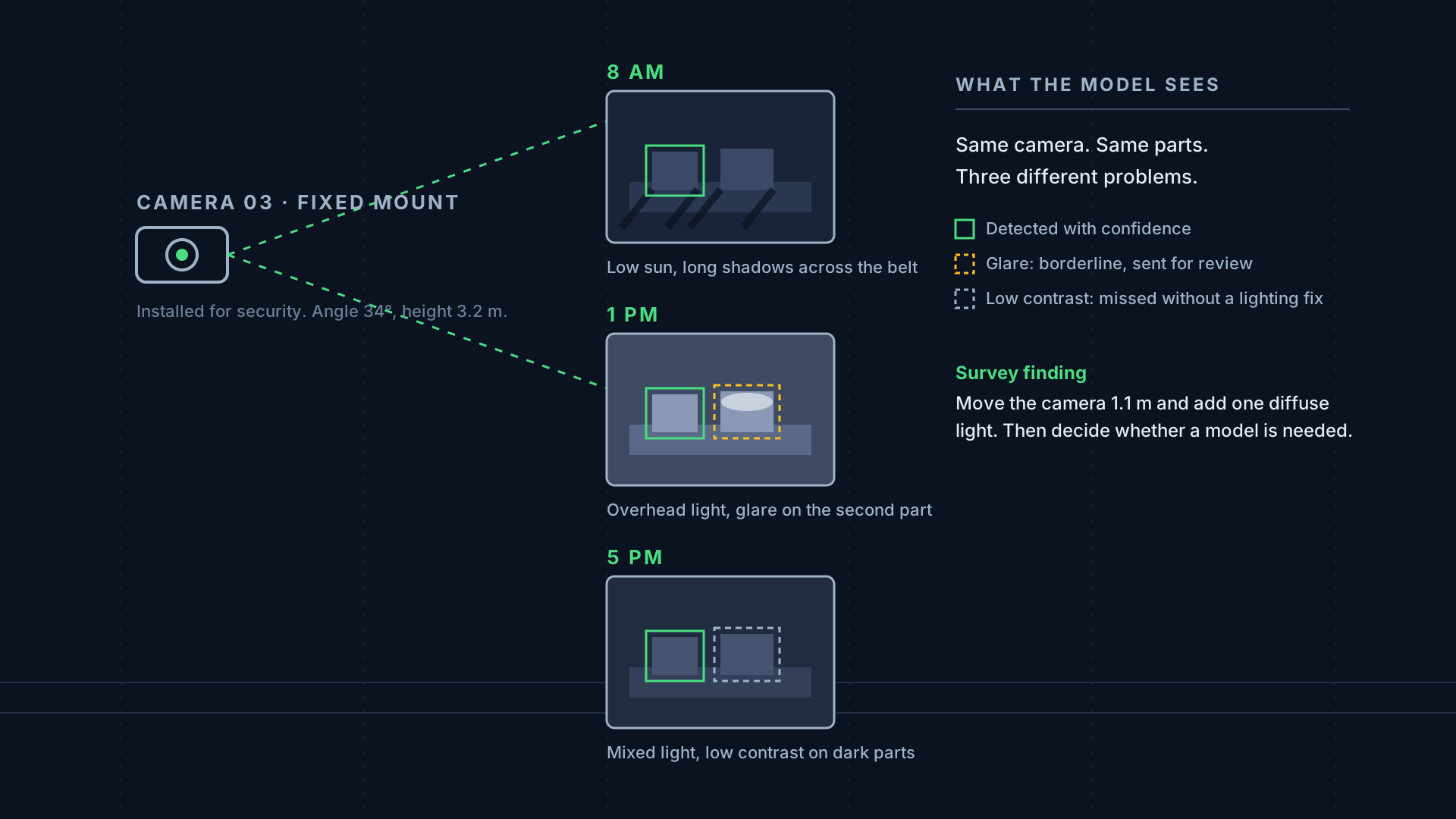
We look at your site before we quote the model.
Most vision projects start with a spec sheet. We start by looking at your actual floor, your lighting, and your cameras. That is where the real answer lives. Often, the best solution is not a complex model; it is a simple shift in camera angle or lighting. We would rather tell you that in week one than leave you chasing a dead end four months later.
Half the vision problems we are asked to solve are lighting problems wearing a machine learning costume.
Discuss your vision projectOf SaaS and AI leadership behind every build
Products built on our founder's frameworks
Computer vision that sees what matters to your business
From quality inspection to document and video intelligence.
Finding the thing, and spotting when something is wrong. Catch problems before they become expensive.
Spot product defects using your real defect library, not a generic dataset.
Count products, vehicles, people, or equipment automatically.
Check that every part is present and assembled correctly before it moves on.
Take measurements from images when manual or contact measurement is difficult.
The right accuracy depends on what a mistake costs you.
Every vision system has to make a choice between false alarms and missed cases.
If missing a crack in a safety-critical part could put someone at risk, you may accept more false alarms to catch every possible defect. If a false alarm stops a high-speed production line, the cost can be very different.
There is no single ‘best’ accuracy setting. The right balance depends on your business, which is why we define it with you before the build and make it part of the acceptance criteria.
We then test different thresholds, show you what each one means in practice, and adjust them again once real production data starts coming in.
Catch almost everything
- More false alarms
Reduce false alarms
- Higher chance of missing a case
Which mistake costs you more?
Put the model where the decision needs to happen.
Some decisions need to happen in milliseconds. Others can wait.
If a system needs to reject a faulty part before it leaves the production line, processing may need to happen directly on the device. If the job is reviewing yesterday's footage, cloud processing may be simpler and more cost-effective.
Many real-world systems use both. We work out the right balance based on speed, bandwidth, cost, security, and where your data needs to stay before choosing the hardware.
Camera
Edge device
Speed
Network
Bandwidth
Cloud
Data residency
Business system
Specialists across engineering, AI, design, and delivery
Deployment ships with monitoring, an uncertainty route, and a documented retraining path
Common questions about computer vision
From data requirements to what happens when the model gets it wrong.
How much labelled data do we need?
Less than you might expect for common objects, but rare defects are a different story. Where important defects are difficult to capture, we can combine targeted data collection, synthetic data, and approaches that learn what normal looks like. The right approach depends on your footage and the problem you need to solve, so we assess that during discovery.
Can you use our existing cameras?
Often, yes. Using the cameras you already have can be the simplest and cheapest place to start. But a camera installed for security may not be suitable for inspection. Sometimes moving one camera or improving the lighting does more for the result than adding more software. The site survey tells us which situation you are in.
What accuracy can you achieve?
We do not give you a made-up accuracy number before seeing your data. Instead, we agree on what the system needs to achieve for your particular use case, test it against production-representative data, and tell you honestly whether your environment can support that target.
What happens when the model is unsure?
It does not have to guess. An uncertain case can be sent to a person, passed to a second model, or placed in a review queue, depending on what your process allows. We design that path as part of the system from the beginning.
Does this work with people in frame?
Yes, but privacy needs to be considered from the start. Depending on the use case, we can design for on-device processing, minimise what is stored, or blur and remove identifying details that the system does not need.
Can you improve an existing computer vision system?
Yes. You may not need to start again. If your current system works in testing but struggles in production, we can assess the data, cameras, environment, model, and decision process to find where the problem is coming from. Sometimes the model needs work. Sometimes the data does. Sometimes the camera or lighting is the real problem.
Selected work
AI systems running in production, described rather than named.
 An industrial hygiene consultancyTurning lab data into review-ready reportsLab PDFs read automatically, exposure limits checked against the right jurisdiction, and report prose generated with the regulation cited.Under 1 hrto produce a report that used to take six to tenRead the case
 A US remote-monitoring healthtechSupporting rehabilitation after dischargeRemote therapeutic monitoring built so the billing qualification cannot be faked, with an AI care plan no patient sees unapproved.15 mina day for a physician to review a full patient panelRead the case
 A US medical equipment resellerBuilding a sales channel the business could ownA storefront of their own beside a high-volume eBay business, with inventory kept in step both ways and double sales resolved automatically.5 minfor stock to reflect across both sales channelsRead the case
What we build with
Models
- Anthropic Claude
- GPT (OpenAI)
Services
- FastAPI (Python)
- PostgreSQL
- AWS S3
Delivery
- AWS
- Docker
- Sentry




Partners in delivery

Ready to find out if computer vision can work for you?
Send us some sample footage and tell us what you need the system to catch. We will tell you what is feasible, what the build would require, and whether a better camera or better lighting could solve the problem more simply than a model.
No pitch. Just an honest assessment of what will work.