

Healthtech
Building an e-prescription platform around trust, access, and scale.
A UK healthtech founder needed one secure platform connecting patient management, prescribing, electronic signing, pharmacy access, and usage-based billing. SDTC Digital designed and built the core platform in 16 weeks.
- Core platform delivery
- 16 weeks
- Prescriptions in one bulk-signing action
- Up to 25
- Required for pharmacy access
- No registration
- Usage-based billing model
- Pay per prescription
Project overview
Private prescribers had no single place to manage patients, write prescriptions, and get them legally signed and dispensed. The pieces existed separately, and nothing joined them.
An electronic prescription is not simply a digital record of a signature. Under eIDAS Article 26, it has to meet a specific standard for the signature itself to be valid, and that requirement ran through the architecture from the start: identity verification and biometric signing were built in from the first development phase.
The business model added a second constraint. Prescribers pay per prescription, so usage-based billing had to work from the day the platform went live.
- Signature provider
- DigiIdentity (OIDC + AES)
- Drug validation
- NHS DM+D dictionary
- Pharmacy access
- No registration required
- Tenancy
- Solo prescribers and multi-clinic orgs
Project details
- Electronic signing
- DigiIdentity through OIDC and AES
- Medicines data
- NHS DM+D
- Pharmacy access
- Code and date-of-birth verification
- Account structure
- Solo prescribers and multi-clinic organisations
The Challenge
- 01Connected patient management, prescribing, signing, dispensing, and billing without adding administrative work for prescribers.
- 02Embedded identity verification, biometric confirmation, auditability, and prescription integrity throughout the complete prescription lifecycle.
- 03Enabled pharmacies to retrieve and dispense prescriptions securely without requiring registration or creating counter-side adoption friction.
- 04Operationalised usage-based billing by linking prescriptions, transactions, token balances, payments, and automatic top-ups accurately.
- 05Supported multi-clinic administration and billing while keeping each clinic's patient and prescription data securely separated.

Project goals
- Deliver the core clinic management and e-prescription platform within 16 weeks.
- Design the signing workflow around advanced electronic signature requirements.
- Give pharmacies secure prescription access without requiring an account.
- Introduce usage-based billing from the first release.
- Support both independent prescribers and multi-clinic organisations.
- Create a traceable prescription lifecycle from draft to dispensing.
- Launch with a public website and a clear sign-up journey.
What we built
SDTC Digital developed a clinic-management and e-prescription platform covering the complete journey from patient selection to pharmacy dispensing.
Connected prescribing workflow
Patient selection, prescription preparation, signing, pharmacy retrieval, and dispensing follow a guided process.
Identity verification and electronic signing
DigiIdentity verifies patients, supports biometric confirmation, enables advanced signatures, and tracks prescriptions securely.
Pharmacy access and notifications
Pharmacies retrieve prescriptions without accounts. SendGrid and Twilio automate alerts, billing updates, and security notifications.
Billing and clinic account management
Stripe manages checkout, subscriptions, prescription usage, and top-ups. Administrators manage users and billing centrally.
Data and platform administration
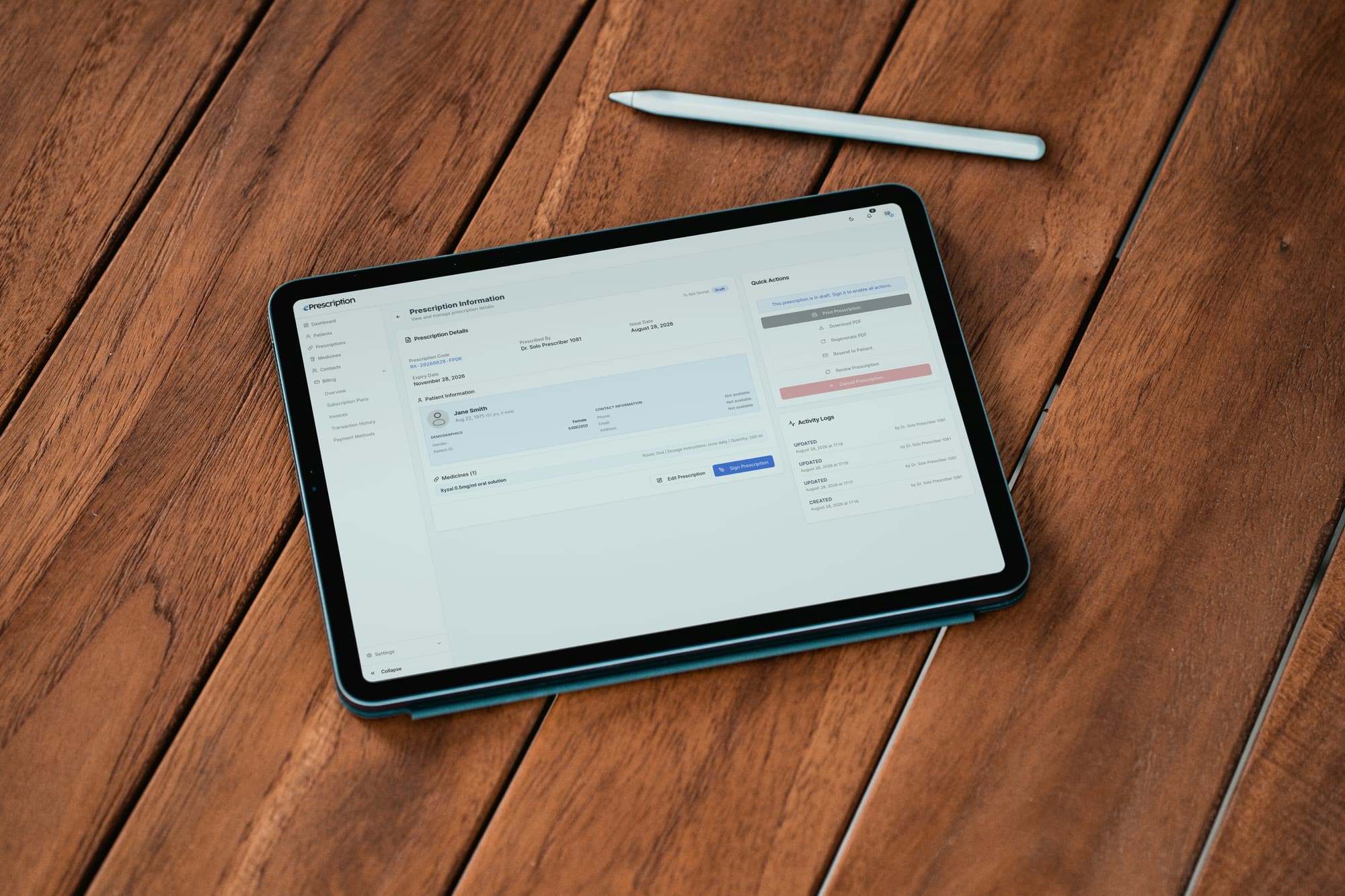
Administrative tools manage records, imports, duplicate merging, bulk signing, clinics, users, reporting, and billing adjustments.
Swarnendu is one in a billion, I am generally very reserved when it comes to recommending IT personnel, however I make the exception when speaking of this man and his team. Swarnendu is the most helpful, fast acting, highly technical leader that I have ever seen.
 Dan AuitoMentorship Director at Business Mentors 101
The User Journey
Select or add the patient
The prescriber finds an existing patient, imports patient data, or creates a new record.
Prepare the prescription
Medication is selected using NHS DM+D data, and the required prescribing information is entered.
Verify identity and sign
The prescriber completes the DigiIdentity signing journey, including biometric confirmation.
Share the prescription securely
The patient or pharmacy receives the information required to retrieve the prescription.
Verify and dispense
The pharmacy uses the prescription code and the patient's date of birth to access the record and mark it as dispensed.
The Thinking Behind the Platform
- 01Signing-first architecture: Built identity verification, biometric confirmation, audit trails, and error handling into the core workflow.
- 02Account-free pharmacy access: Enabled secure prescription retrieval using a code and date of birth, with rate limiting.
- 03Transactional bulk signing: Added validation and rollback logic to prevent partially signed batches.
- 04Separated administration: Kept clinic and platform controls in distinct interfaces.
- 05Standard medicines data: Used NHS DM+D for consistent medication search and identifiers.
- 06Built-in product support: Added an LLM-supported assistant for navigation and common platform questions.
Tech stack
Frontend
 React
React TypeScript
 Material UI
 Redux Toolkit
Backend and infrastructure
 FastAPI
 Python
 Appwrite
 PostgreSQL
 Redis
Redis Nginx
Nginx
Integrations
- DigiIdentity
 Stripe
 SendGrid
 Twilio
Clinical terminology
 NHS DM+D
Testing and results
710
Documented test cases covering prescription states, authentication, identity controls, billing, pharmacy dispensing, clinic management, and platform administration.
147
Test cases dedicated to the administration portal, covering user management, billing controls, reporting, and platform operations.
14
Admin testing categories used to validate the platform's operational and management workflows before handover.
16 weeks
Core delivery across four structured phases, followed by an additional workstream for bulk signing, patient merging, notifications, and billing controls.
Business impact
- One workflow replaces several disconnected tools, with fewer barriers for pharmacies to get started.
- One product serves both individual prescribers and larger clinics, cutting repetitive work for busy prescribers.
- Every claimed feature was checked against the live, running codebase rather than just the spec: 67.6% of tested platform functionality was confirmed fully built and working end-to-end on first verification pass, a rigorous bar for a 16-week core build.
- The Platform Admin Portal, which runs billing, user management, and reporting for every clinic on the platform, passed its full 147-case test suite with zero outright failures.
- 710 test cases in total covered prescription states, identity verification, billing, pharmacy dispensing, clinic management, and platform administration.
More work
Every engagement
EdTech
Turning every sale into an enrolment
Shopify and direct checkout feeding a single SCORM platform that provisions accounts, tracks progress and issues certificates unattended.

Compliance
Turning lab data into review-ready reports
Lab PDFs read automatically, exposure limits checked against the right jurisdiction, and report prose generated with the regulation cited.

 Healthtech
Making surgery clearance easier to track.
Referrals, pre-authorisations and clearances tracked in one place, with a rules engine that decides when a patient is ready.
Regulated software is mostly getting the edges right.
If compliance is the reason your product has not shipped, that is usually an architecture conversation before it is a legal one.