
 MedClearance
Healthtech
Making surgery clearance easier to track.
A US healthcare practice needed a clearer way to manage referrals, insurance pre-authorisations, medical clearances, and patient follow-ups. SDTC Digital delivered the production-ready platform in four weeks.
- Production delivery
- 4 weeks
- Referral, pre-authorisation and clearance
- 3 requirements
- In-app and email follow-up reminders
- Automated alerts
- Code and credentials transferred
- Full ownership
Project overview
The practice managed pre-procedure requirements through spreadsheets, making it difficult to track referrals, insurance authorisations, medical clearances, procedure dates, and patient follow-ups. Staff had to review records manually, increasing the risk of missed documentation and delayed action.
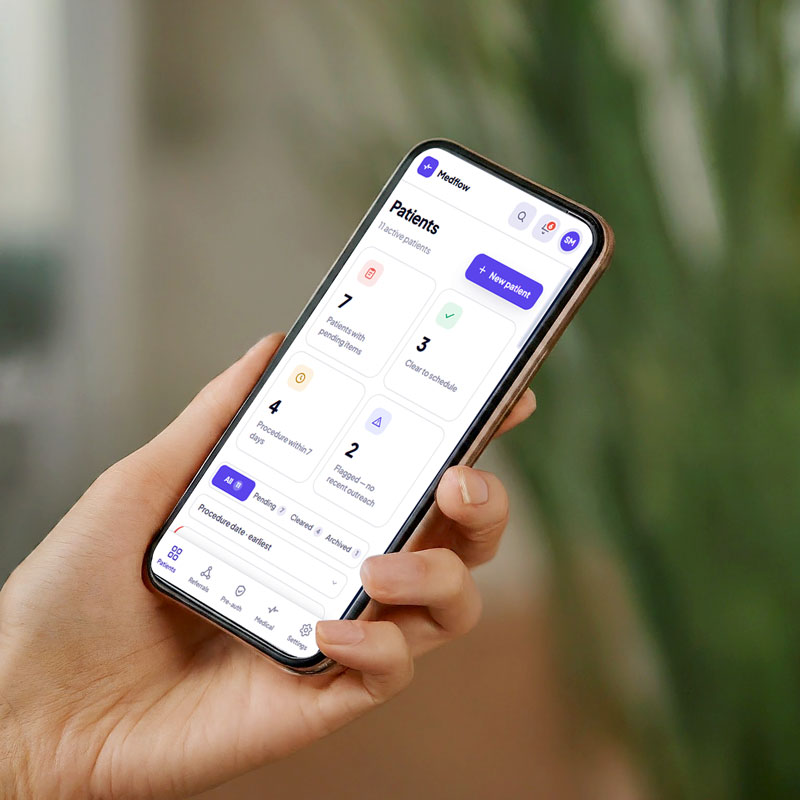
A new shared platform centralised the clearance process. It tracks each patient's requirements, calculates readiness, records outreach activity, and alerts staff when follow-up is overdue or a procedure date is approaching.
The platform was delivered in four weeks using milestone-based development, weekly staging reviews, and written approval at each stage. At handover, the client received full ownership of the codebase, domain, credentials, and connected service accounts, providing a complete and maintainable system for managing surgical readiness.
- Replaced
- Manual spreadsheet tracking
- Categories tracked
- Referral, pre-auth, clearance
- Devices
- Desktop and tablet
- Post-launch
- 30-day bug support included
Project details
- Replaced
- Manual spreadsheet tracking
- Requirements tracked
- Referral, pre-authorisation and medical clearance
- Supported devices
- Desktop and tablet
- Post-launch support
- 30-day bug support
The challenges
- 01Three separate pre-procedure requirements were being tracked manually, with no single view showing what had been received and what was still outstanding for each patient.
- 02The spreadsheet recorded information but could not evaluate it, so staff still had to check every requirement before deciding whether a patient was clear to schedule.
- 03Nothing automatically flagged patients whose paperwork had stalled or whose procedure date was approaching.
- 04Follow-up activity was not consistently recorded in one place, making it difficult to see who had contacted a patient, what had been discussed, or when the next action was due.
- 05The application had to remain clear and usable for front-desk and back-office staff working across desktop and tablet devices.
Project goals
The practice needed a platform that could:
- Replace spreadsheet tracking with a purpose-built web application.
- Track referrals, pre-authorisations, and medical clearances separately.
- Calculate when every required item has been received.
- Show staff which patients were ready to schedule.
- Maintain a permanent record of every patient outreach action.
- Flag cases requiring urgent or overdue follow-up.
- Support multiple staff accounts and administrator-controlled access.
- Work across desktop and tablet devices.
- Launch within four weeks.
What we built
SDTC Digital developed a responsive clearance-tracking platform that gives practice staff one shared view of patient requirements, outreach activity, and scheduling readiness.
Clearance-focused patient records
Create, search, filter, sort, edit, and archive patient records organised around procedure requirements.
Independent requirement tracking
Track referrals, insurance pre-authorisations, and medical clearances separately for each patient and case.
Automatic readiness and status visibility
Calculate completion automatically and use colour-coded indicators to show case status at a glance.
Focused work queues and alerts
Monitor category-specific cases, outstanding requirements, inactive cases, approaching procedures, and missing documentation.
Auditable follow-up and account management
Record every outreach action while managing staff access, passwords, lockouts, and deactivation.
They took the coldness out of the tech world for me. Some of their vision and ideas were really enlightening.
 Christina CavageOwner, Bella Lingua LLC
The User Journey
Create or locate the patient
A staff member adds a patient record or searches for an existing case.
Select the required categories
The staff member identifies whether the patient needs a referral, pre-authorisation, medical clearance, or a combination of the three.
Record follow-up activity
Every call, email, or other outreach action is added to the relevant category log.
Update received items
When documentation arrives, staff mark the corresponding requirement as received.
Review and act on readiness
The platform evaluates readiness, updates clearance status, and prioritises cases needing attention.
Tech stack
Kept simple on purpose. A tool a practice depends on daily should be dull to run.
Application
- Responsive web application
- Desktop and tablet
Environments
- Dedicated staging
- Production
Security and access
- HTTPS
- Individual staff accounts
- Password reset
- Login lockout
- Administrator-controlled access
Notifications
- Automated email delivery
- Daily summaries
- Procedure-date alerts
Ownership
- Client-owned domain
- Codebase
- Credentials
- Service accounts
Testing and Delivery
195
Structured test cases executed across patient records, clearance rules, outreach history, alerts, accounts, administration, and responsive behaviour.
27
Defined user stories supported by testable acceptance criteria across the complete patient-clearance workflow.
10
Functional areas tested, with category views, account management, and responsive interfaces achieving a 100% pass rate and no critical defects remaining open.
4 weeks
Milestone-based delivery with weekly staging reviews, written client approval before release, and 30 days of post-launch bug support.

Outcomes and Business Impact
- One shared system shows which patients are ready and which requirements remain outstanding, with readiness calculated automatically the moment a requirement comes in, replacing manual spreadsheet checks.
- A permanent, staff-attributed record of patient outreach.
- Earlier visibility of inactive cases, approaching procedure dates, and category-specific staff queues.
- Category management, account access, and the responsive interface, the parts staff touch every day, passed with a perfect score and zero critical defects.
- Secure desktop and tablet access, with full ownership of the codebase, domain, and connected service accounts, delivered on a 4-week milestone schedule with weekly staging sign-off and no dependency on a long-term software vendor relationship.
- The practice manager stopped needing to open the spreadsheet from day one of using the system.
More work
Every engagement
Medical E-commerce
Building a sales channel the business could own
A storefront of their own beside a high-volume eBay business, with inventory kept in step both ways and double sales resolved automatically.

Enterprise SaaS
Infrastructure first, features second.
Strategic scorecarding, assessments and innovation pipelines as separately licensable modules, on infrastructure built before feature one.

 Healthtech
Supporting rehabilitation after discharge
Remote therapeutic monitoring built so the billing qualification cannot be faked, with an AI care plan no patient sees unapproved.
Still handling critical workflow through spreadsheets?
The problem is rarely the spreadsheet itself. It is the manual checking, missed follow-ups, unclear ownership, and decisions that depend on someone noticing the right row at the right time.